
The Second IATB-MSF Webinar on Tuberculosis Clinical Research-Paediatric TB Successfully Held Online
On July 24, 2025, the second IATB-MSF webinar on TB clinical research – Paediatric Tuberculosis, jointly hosted by the Innovation Alliance on Tuberculosis Diagnosis and Treatment (Beijing, hereinafter IATB) and Médecins Sans Frontières (MSF), was successfully held online. The event received technical support from the Beijing Chest Hospital, Capital Medical University, and the Clinical Center for Tuberculosis, China CDC.
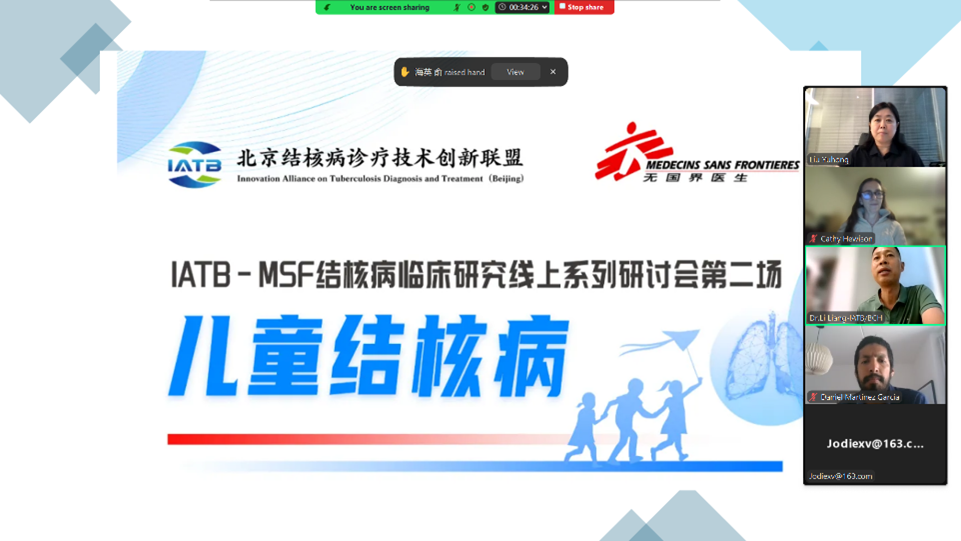
The webinar was moderated by Prof. Yuhong Liu, Vice Chairman of the Innovation Alliance, and Dr. Yuan Huang, Medical Representative of MSF Beijing Office. Professor Liang Li, Chairman of the Innovation Alliance and deputy director of the Beijing Chest Hospital, Capital Medical University, delivered the opening address. He pointed out that paediatric tuberculosis has long been a neglected public health issue, marked by a massive gap in case detection and numerous diagnostic challenges. There is a lack of child-friendly pharmaceutical formulations for treatment, and clinical trials targeting paediatric tuberculosis remain extremely scarce. He expressed hopes that Chinese and international scholars could leverage this valuable academic exchange platform to share insights and jointly advance research on paediatric tuberculosis.
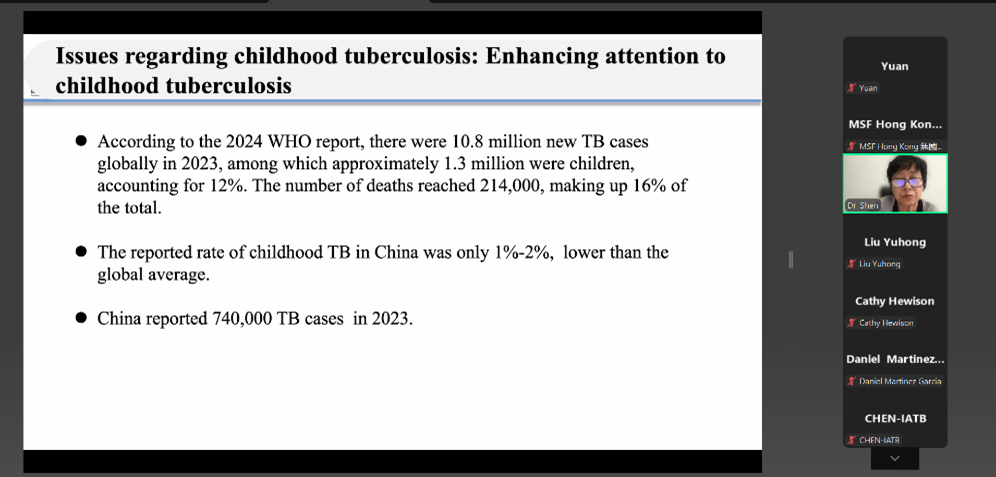
Professor Adong Shen from the Beijing Children’s Hospital, Capital Medical University, first presented the current status and technical hurdles in paediatric tuberculosis diagnosis and treatment. She explained that children produce scant sputum and low bacterial loads, limiting the utility of traditional bacteriological testing for paediatric TB diagnosis. Non-sputum specimens including gastric fluid, bronchoalveolar lavage fluid (BALF) and stool are of great diagnostic value for children. Rapid molecular assays such as Xpert MTB/Ultra deliver favorable sensitivity and specificity for detection. Additionally, paediatric tuberculosis presents highly variable clinical manifestations, with a high proportion of extrapulmonary tuberculosis cases, calling for rigorous differential diagnosis to achieve accurate confirmation.
Regarding treatment, Professor Shen noted that out of over 40 global clinical trials on tuberculosis treatment conducted in recent years, only two enrolled children and adolescents. This results in weak evidence base for paediatric TB treatment regimens, forcing clinicians to formulate treatment regimens for children by referencing adult guidelines. She further illustrated diverse clinical challenges encountered in domestic paediatric TB practice through two clinical case studies, and emphasized an urgent need to raise awareness of paediatric tuberculosis among general hospital practitioners and strengthen their capacity to differentiate TB from other childhood illnesses.
Subsequently, Dr. Daniel Martinez Garcia and Dr. Cathy Hewison from MSF shared new findings and implications from the ALGO-PED Study, covering paediatric TB diagnosis and treatment respectively.
Dr. Garcia first outlined the design and key outcomes of MSF’s ALGO-PED Study, implemented among children under 10 years old across five African countries. The primary objective was to evaluate the feasibility and acceptability of the WHO-recommended new pediatric tuberculosis treatment decision algorithms (TDAs) for grassroots implementation. Secondary objectives included assessing children’s clinical status and mortality two months post-treatment completion for patients initiated on treatment via TDAs; evaluating the diagnostic performance of urine lipoarabinomannan lateral flow assay (TB-LAM), tongue swabs and point-of-care ultrasound (POCUS) in paediatric populations; comparing changes in case detection rates before and after TDA rollout; and measuring the proportion of eligible children suitable for the 4-month treatment regimen and its practicality.
The study demonstrated strong diagnostic performance of the new TDAs, which were widely regarded as feasible and acceptable by frontline healthcare workers and worthy of broader uptake. Implementation of the new TDAs increased the number of children starting anti-tuberculosis chemotherapy, improved identification of presumptive paediatric TB cases, and boosted grassroots medical staff’s confidence in managing paediatric tuberculosis. However, persistent stigma and misconceptions surrounding tuberculosis remain prevalent.
Findings from ALGO-PED underscored the need for wider adoption of standardized clinical assessment tools for paediatric TB, expanded use of non-sputum specimen testing, point-of-care molecular diagnostics, and computer aided detection (CAD) tools such as chest radiography and portable ultrasound for children. AI-powered acoustic diagnostic devices are also under development, with smart stethoscopes poised for future application in paediatric TB screening. Dr. Garcia added that greater potential of existing diagnostic tools for paediatric TB case detection remains to be unlocked.
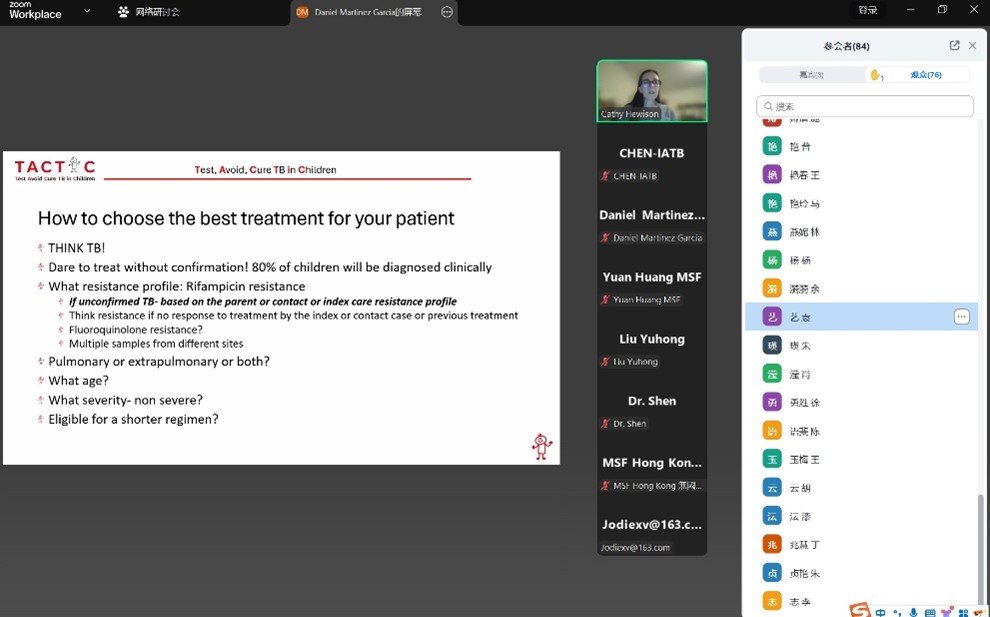
Dr. Cathy Hewison, Director of the MSF Tuberculosis Department, then shared treatment-related takeaways from the ALGO-PED Study. She stressed that early initiation of anti-tuberculosis therapy outweighs definitive bacteriological confirmation, and clinicians must maintain a high index of suspicion for tuberculosis, as up to 80% of paediatric cases are diagnosed clinically without microbiological confirmation.
Critical considerations include drug susceptibility testing results to identify rifampicin-resistant and fluoroquinolone-resistant TB strains, which requires multi-site, multi-type specimen collection for drug susceptibility testing (DST). Where access to reliable susceptibility testing is limited, contact tracing of close TB contacts can help infer the likelihood of drug-resistant disease. Clinicians must further distinguish pulmonary from extrapulmonary tuberculosis, stratify patients by age and disease severity, and determine eligibility for shortened treatment regimens.
Dr. Hewison shared MSF’s practical experience with the 4-month regimen 2HRZ(E)/2HR for drug-susceptible, non-severe paediatric tuberculosis. High-quality chest radiography and standardized radiograph interpretation training for frontline clinicians are foundational to successful delivery of this short course regimen. Comprehensive tuberculosis health education for children and their families is equally vital to enhance treatment adherence and expand coverage of tuberculosis preventive therapy.
She concluded by highlighting the central role of clinical diagnosis in paediatric tuberculosis management, calling for risk stratification to accelerate treatment initiation, broader access to DST using diverse specimen types at grassroots facilities, and improved supply of child-friendly anti-tuberculosis medications — to ensure paediatric TB patients have accessible diagnostic pathways and appropriate therapeutic options.
The online webinar fostered a vibrant academic atmosphere, attracting more than 100 participants nationwide who actively raised questions to the presenting experts. Specialists shared clinical insights and research perspectives, offering detailed responses and in-depth discussions on submitted queries. The academic event concluded successfully and received high acclaim from all attendees.
The Innovation Alliance will continue to co-host a series of follow-up tuberculosis research seminars on diverse thematic topics in collaboration with MSF. Further updates will be released in due course.
Reported by Chen Zi, Innovation Alliance